Go to Blogger edit html and find these sentences.Now replace these sentences with your own descriptions.This theme is Bloggerized by Lasantha Bandara - Premiumbloggertemplates.com.
Go to Blogger edit html and find these sentences.Now replace these sentences with your own descriptions.This theme is Bloggerized by Lasantha Bandara - Premiumbloggertemplates.com.
Go to Blogger edit html and find these sentences.Now replace these sentences with your own descriptions.This theme is Bloggerized by Lasantha Bandara - Premiumbloggertemplates.com.
Go to Blogger edit html and find these sentences.Now replace these sentences with your own descriptions.This theme is Bloggerized by Lasantha Bandara - Premiumbloggertemplates.com.
Go to Blogger edit html and find these sentences.Now replace these sentences with your own descriptions.This theme is Bloggerized by Lasantha Bandara - Premiumbloggertemplates.com.
The Ford Focus diesel makes a compelling case for high-mileage drivers, rivalling the VW Golf TDI and Kia Ceed CRDi
The
automatic diesel edition of the new Ford Focus makes a strong case for
itself; it’s a refined cruiser and the gearbox is a smooth performer. So
long as you don’t try to rush it, the chassis has bags of ability that
you simply won’t find in any other family car, too. For keen
high-mileage drivers, it’s a compelling option, but for everyone else
there are petrol editions that are cheaper, quieter, and even more fun.
Diesel may be going through a tough time, but it’s still a good choice for people who rack up plenty of miles. And the new Ford Focus EcoBlue is designed to offer that option to family car customers, rivaling everything from the Volkswagen Golf TDI to the Kia Ceed CRDi.
EcoBlue will be a new name to many; it’s Ford’s
attempt to piggy-back the popularity of the EcoBoost small petrol
engines, which have a reputation for being efficient, strong performers.
In the Focus’s case EcoBlue means a 1.5-litre four-cylinder diesel, and
it’s being offered in a couple of states of tune.
There’s
a 94bhp (95PS) version with 300Nm of torque and CO2 emissions as low as
91g/km, and then there’s the 118bhp (120PS) edition we’re testing here,
which has the same torque figure and emits as little as 94g/km of CO2.
The Focus range also includes a 2.0 diesel, incidentally; it has 148bhp
(150PS) and 370Nm, and emits from 114g/km of CO2, depending on wheel
size.
There’s
another factor that we have to consider here, though - and that’s
transmission. Because the new Focus is the first Ford to be offered with
a new eight-speed torque-converter automatic gearbox - a replacement
for the Mk3 Focus’s unloved dual-clutch PowerShift set-up. The unit is
also offered on the larger diesel, plus the 123bhp 1.0 and 148bhp 1.5
petrols.
So while you can have your Focus diesel with
a six-speed manual, we’re testing the eight-speed auto here - thereby
sampling two of the freshest elements in the new package.
There’s
no mistaking the fact you’re in an auto when you climb inside - because
there’s not even a stubby auto gear selector in place of the regular
six-speed stick. Instead you get a slim rotary dial positioned at the
base of the centre console. It may not rise majestically into use as the
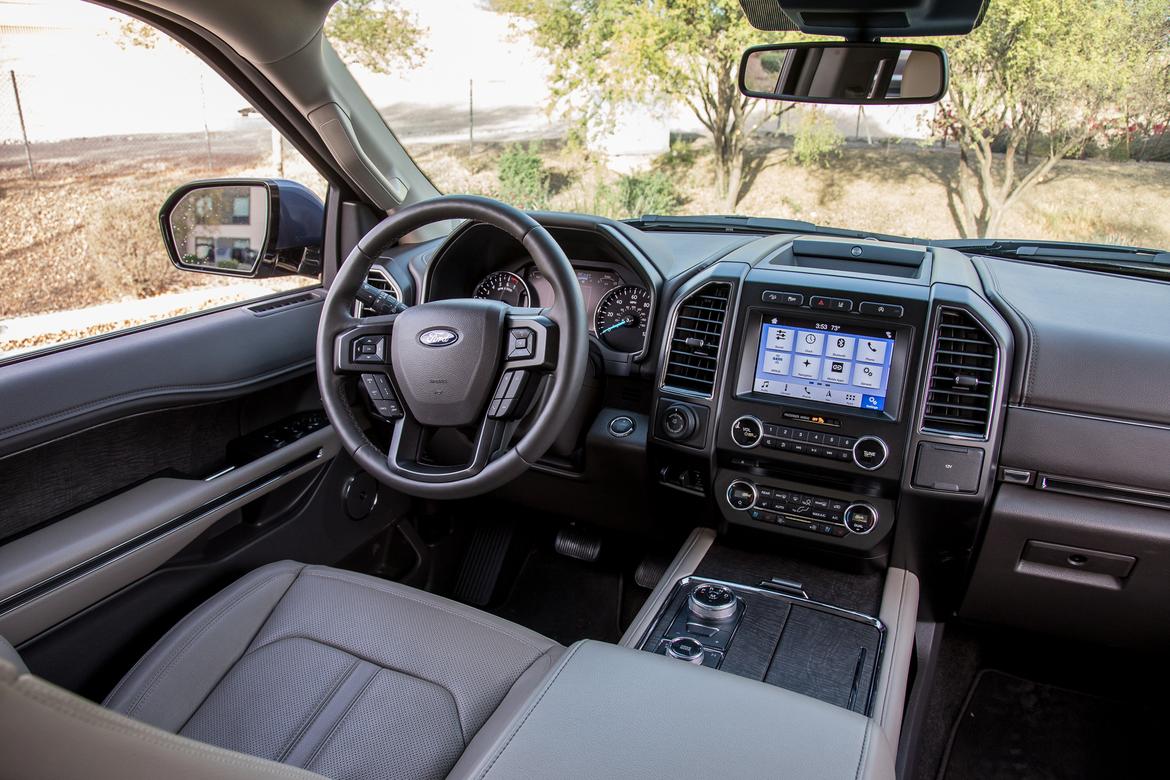
car fires up – as it does in Jaguar’s similar configuration – but it does free up a little more space between the front seats. And it’s a doddle to use, too.
You’re
not likely to mistake the diesel for a petrol when you press the
starter button, either, because the initial signs are that it’s a bit of
a grumbler. There’s no intrusive judder to speak of, but it would be
too much to say that the EcoBlue fires up with the smoothness of a
petrol car. Rivals do a better job of disguising your choice of fuel
type.
Still,
as you pull away, things improve. The EcoBlue’s manners improve as it
warms up, and it has enough power and torque to feel entirely
comfortable in a vehicle of the Focus’s size and weight. There’s shove
from less than 2,000rpm, in fact, and while you can rev the engine out
to 4,500rpm if you so desire, you really won’t need to go there in
normal driving.
The new Focus’s handling has already
impressed us greatly in petrol editions and the good news is that the
1.5 diesel (which gets the simpler twist-beam rear suspension instead of
a multi-link set-up) is very much cut from the same cloth. There’s a
little more weight over the nose, but if the car is any less responsive
to inputs – or any more reluctant to point its nose towards the inside
of a corner – it’s by the smallest of margins.
Pressing
the ‘M’ button in the middle of the gear selector allows you to use the
steering wheel-mounted paddles to control the car’s shifts. You can
make rapid progress, in fact, because the diesel’s extra low-down torque
allows you to carry plenty of speed through corners and quickly regain
it if you do lose momentum.
The gearbox isn’t
flawless; it’s prone to the occasional clumsy shift, and despite Ford’s
claims about its ability to adapt to both road gradients and the
driver’s character, it can still leave you tantalisingly short of the
engine’s sweeter rev range. Our impression, after a few hours of driving
in town, motorway and on challenging B-roads, is that the seven-speed
DSG – as seen in VWs, SEATs, Skodas and Audis – is still ever so slightly crisper.
But
the incremental gains over the old PowerShift is considerable; the
combination of the EcoBlue engine and the auto box allows you to harness
the Focus’s excellent ride quality to make it a serene, comfortable
cruiser. You could quite happily twist the shift controller to D, drive
600 miles and then get out of the car without giving the journey you’ve
just completed too much thought. That would be a telling statement for
many executive saloons, let alone a humble family hatchback.
The
rest of the package has the same core strengths as you’ll find
elsewhere in the new Focus range. The rear cabin accommodation is right
up there with the best in class, with room for a couple of six-footers
and no transmission tunnel to annoy the third occupant in the back
seats. The boot is bigger than before, too. At 375 litres it’s a smidgen
off the capacity of the Golf – and it has a bit of a lip to lift heavy items over – but it looks more than enough for most uses
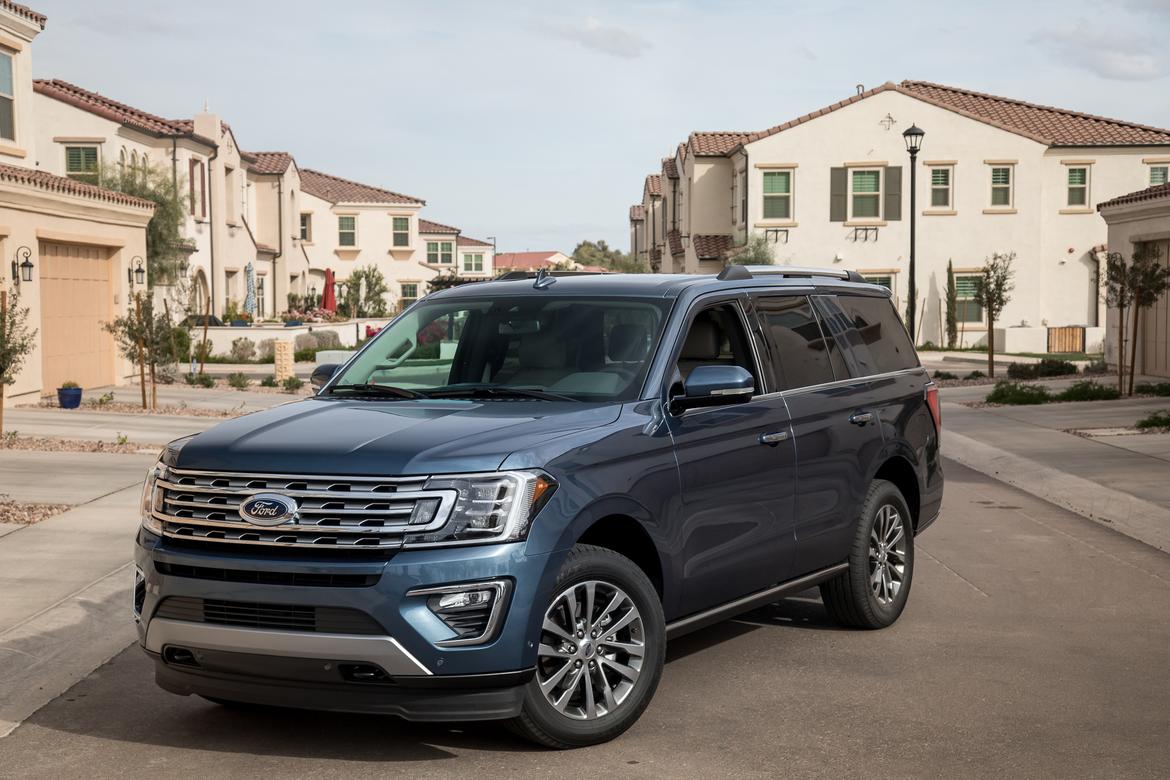
2018 Ford Expedition Review: A Massive Improvement
The verdict:
Big, bold and fully updated, the Expedition has the goods to take the sales crown away from the Chevrolet Tahoe.
Versus the competition:
It may not have a V-8, but you won't miss the two extra cylinders; it
has plenty of power and more usable space and useful technology than any
other SUV in the class.
Just as minivans replaced the family station wagon in the 1980s, so too
did big SUVs vanquish those vans in the 1990s. Since then, however, the
Great Recession and occasional gas price shocks have returned the
largest SUVs to their original role in the market: expensive vehicles
bought by people who need big, multi-passenger vehicles that can tow a
lot of weight. The segment leaders are the Chevrolet Tahoe and its
longer sibling, the Suburban, and it isn't hard to figure out why: Their
main competitor, the Ford Expedition, hadn't seen a major update in
almost a decade. Now all that has changed. Behold the behemoth: an
all-new 2018 Ford Expedition that aims to knock the Chevy off its
top-truck throne — as it did in our Full-Size SUV Challenge.
Old-School Truck, New-School Materials
Like the old Expedition, the new one maintains traditional, trucklike
body-on-frame construction. Under the skin, the Expedition is an F-150
enhanced with an independent rear suspension instead of a solid live
axle. This arrangement also allows for a lower load floor in the cargo
area, enabling the third row to fold away completely — an advantage over
the Chevy Tahoe's seats, which fold flat but not into the floor. The
Tahoe's raised floor eats into cargo space and makes it more difficult
to load objects.
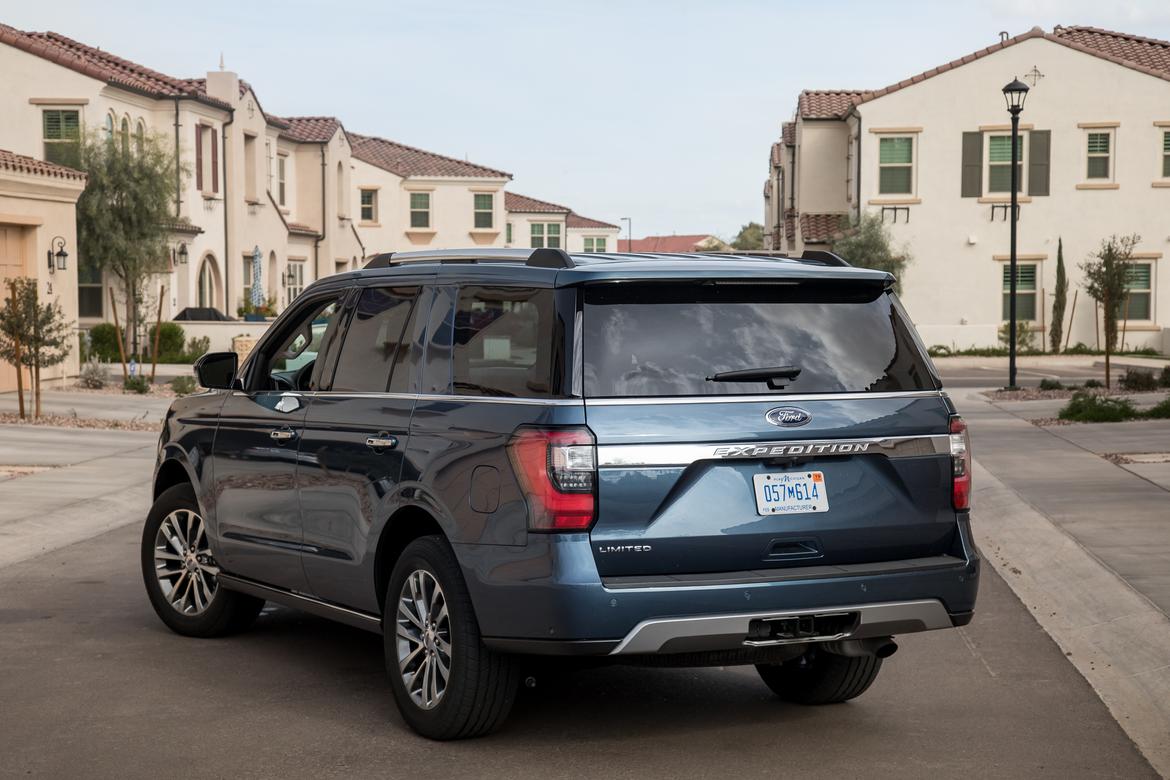
The 2018 Ford Expedition is fully updated, with modern SUV styling.
Cars.com photo by Christian Lantry
Like the F-150, the Expedition's body is now aluminum, but the weight
difference for 2018 isn't that significant — just a 119-pound decrease
for the base trim versus a comparable 2017 Expedition. Ford added all
kinds of equipment and sound insulation that serve to offset some of the
benefit of lightweight aluminum. The body looks slick, with a new and
thoroughly modern appearance that's much more in keeping with the modern
style of truck: high beltline, smaller windows and chunkier style. It's
fresh, attractive and has a distinctly more aerodynamic look than the
outgoing model.
The Expedition comes in two lengths: Expedition and Expedition Max
(formerly Expedition EL). The extra room doesn't do anything for
passenger space, but it does increase the cargo area behind the third
row, so you're not forced to choose between extra rear passengers and
extra luggage capacity. My primary test vehicle was a regular-length
Expedition, though Cars.com editors have also driven the Max.
Old-Style Power, New-Style Engine
Powering the new Expedition is Ford's ubiquitous twin-turbocharged
3.5-liter EcoBoost V-6, a carryover engine. It puts out a healthy 375
horsepower in most trim levels and 400 hp in the top Platinum. New to
the setup is a standard 10-speed automatic transmission — available with
either rear- or all-wheel drive — and an electronic limited-slip
differential.
Fire up the V-6 and it sounds like a well-tuned turbo-diesel. Some of
the engine's noise is artificially generated through the stereo (all
that soundproofing would prevent you from hearing the engine otherwise),
but the sound that does come through is a fun mix of whooshing turbos
and raspy exhaust. It sounds sufficiently butch for the truck it powers.
I found driving it to be quite a pleasant surprise, as well — the V-6
more than adequately powers the Expedition in both regular and Max
versions, and it gets even punchier when you twist the rotary drive mode
selector into Sport. Climbing the canyons above Malibu, Calif.,
handling the tight, twisting sweepers, descending into quick switchbacks
— the Expedition exudes confidence and stability. Sport mode tightens
up steering feedback and changes both accelerator sensitivity and
transmission shift points, making those twisties even easier to take.
Nobody will confuse the Expedition for a Mustang, but it by no means
embarrasses itself on high-speed, challenging roads.
Ride quality is also outstanding. Wheel sizes vary from 18 to 22 inches
depending on trim level and equipment. Higher-spec trims get an
electronically adjustable suspension, but lesser models' suspensions
provide a smooth, well-controlled ride, as well; there are no crazy,
tippy body motions. If you need an off-road rig, Ford's got you covered
there, too: An FX4 package is available that brings underbody
protection, a low-range transfer case, special tuning for the electronic
limited-slip differential, Michelin Primacy tires on smaller wheels,
off-road shocks, a heavy-duty radiator and unique badging.
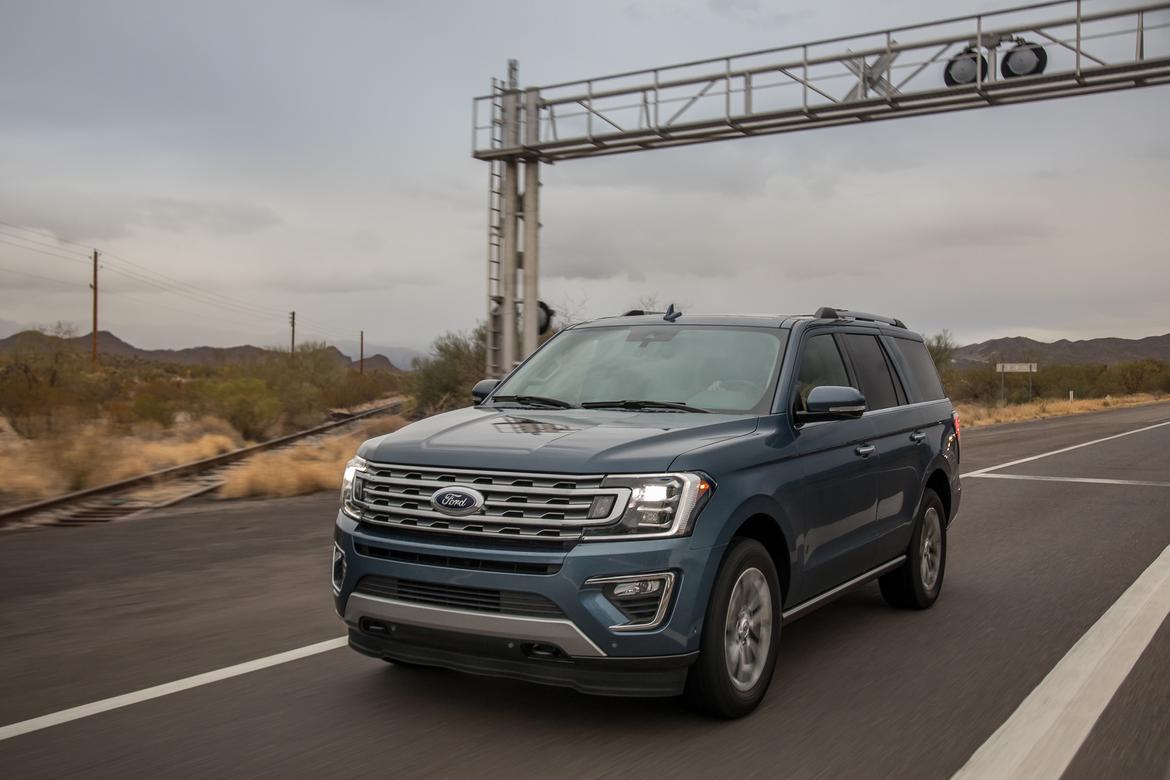
The big Expedition excels at hauling, with plenty of power and electronic aids.
Cars.com photo by Christian Lantry
Hooked up to a 5,500-pound camper, my Expedition towed like a champ,
chugging up 6 percent inclines with ease, accelerating despite the load
it hauled. The 10-speed automatic is well-matched to the engine, holding
gears on downhill grades to save the Expedition's brakes and maintain
easy control. The instrument panel also shows you tons of information,
such as which gear the transmission's in at any given time.
Trailer sway control comes with a heavy-duty towing package, as does
Ford's super-nifty Pro Trailer Backup Assist feature, which allows you
to back up a trailer using a dedicated rotary knob on the dash and
backup cameras. It takes the guesswork and trial and error out of
backing up a trailer, making even the newest novice look like a veteran
trucker.
Hooked up to a 5,500-pound camper, my Expedition
towed like a champ, chugging up 6 percent inclines with ease,
accelerating despite the load it hauled.
Where the Expedition falls short is in fuel economy,
especially when towing. It also features a smaller gas tank than its
main competition, meaning its overall range is notably shorter. The
regular Expedition is EPA-rated at 17/24/20 mpg city/highway/combined
with two-wheel drive, 17/22/19 mpg with four-wheel drive. The longer
Expedition Max clocks in at 17/23/19 mpg with 2WD, 16/21/18 mpg with
4WD. In a recent real-world test for the Full-Size SUV Challenge, my
Expedition 4WD achieved 21.5 mpg in combined driving, better than its 19
mpg rating. But that number dropped dramatically to 10.2 mpg when
towing a camper — a steeper loss than the V-8-powered competitors in our
Challenge exhibited, though still not the lowest mpg. Turns out that
the twin-turbocharged engines positively suck down the petrol when you
put the engine under some serious load, as I did up and down the hills
of eastern Arizona. Combine that with the smaller gas tank, and you'll
be making frequent pit stops if you're towing a trailer cross-country.
Better Inside, But Details Are Important
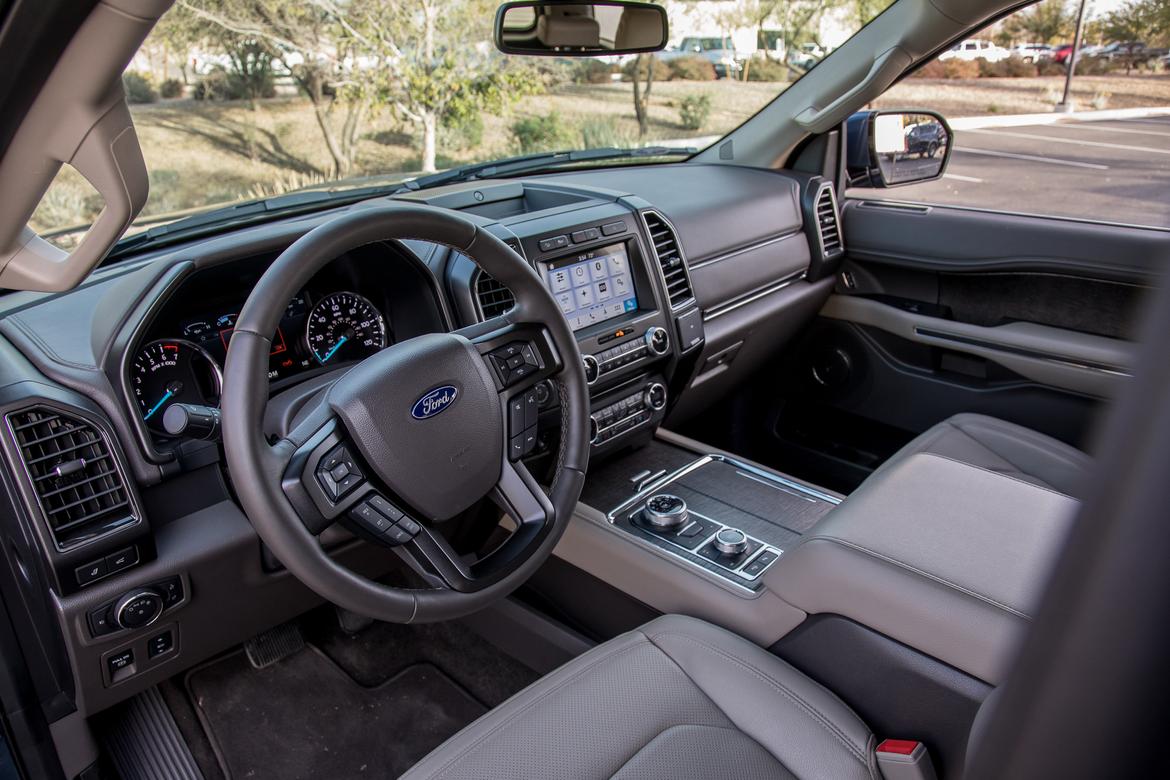
The interior looks as if it could have been lifted directly from the
F-150, with all the pros and cons that entails. It's spacious, with
excellent outward visibility, but the front seats feel unsupportive over
longer voyages. One of our taller reviewers could not get comfortable,
with his legs always at an angle and most of his thighs unsupported by
the oddly short bottom cushions. The backseats are high, with plenty of
room, and the ability to slide fore and aft means passengers in the two
rear rows can negotiate legroom amongst themselves. The third row is
usable for adults even when the second row is adjusted all the way
rearward; slide it forward a bit and there really isn't a bad seat in
the house. The second row also tilts and slides forward at the touch of a
button, making ingress to the third row easier.
While it’s an attractive design, some materials and seams give away its pickup origins.
Cars.com photo by Christian Lantry
Materials quality in the cabin is mixed. The F-150 isn't known for
having the best environment in its own class; it features plenty of hard
plastic and seams between parts that simply don't flow together well.
Some of this, like plastic molding seams on the grab handles, can be
chalked up to early build quality, but some of it is simply how it's
designed — it's a pickup truck that's been given a healthy makeover, but
it's still a pickup truck in the ways that count. For a vehicle that
can easily approach $90,000 in fully loaded Platinum trim and even top
$70,000 for a well-equipped Limited model, this kind of detail is
important. All the fancy quilted leather in the world doesn't excuse the
fact that other parts look cheap.
The Latest Tech
Thankfully, Ford loads you up with tech goodies for that kind of coin,
including gadgets that entertain (you can stream live TV to the
entertainment system via Slingplayer and Sync 3, or even hook up a
big-screen TV for tailgating), some that keep you safe (all kinds of
lane-keeping aids, steering aids, anti-collision aids and autonomous
braking systems), and some that help you drive (like the aforementioned
trailer backup assist). The high-end audio system is by the new B&O
Play brand, a division of Bang & Olufsen, and it sounds fantastic.
The entire experience in the Expedition is one of a significant
upgrade, easily on par with the Chevy and GMC models on many levels and
surpassing them in flexibility, spaciousness and amenities.
All This Utility Does Not Come Cheap
If you haven't priced out a full-size SUV in awhile, you'd better sit
down for this next part. The starting price for an Expedition XL 4x2 is
$49,290 including destination charges, but you'll never see that price
on a dealer lot — they're meant for fleet sales to utilities or city
governments.
Far more likely to be found is an XLT trim, which starts at $52,985
with two-wheel drive. Specifying four-wheel drive adds between $3,000
and $3,200 to the price depending on trim level. Add in everything you
can get and you're looking at an Expedition Max Platinum 4x4 that will
stop just short of 85 grand.
My regular-length Limited 4x4 model stickered at $72,655 including
destination, and that included several popular equipment packages and
leather for the first and second rows. For comparison's sake, the new
2018 Lincoln Navigator starts around $73,000 and can top out around
$100,000.
Still, the Expedition's price is easily competitive with vehicles like
the Tahoe, Suburban and GMC Yukon. It comes in at a bit more than the
Nissan Armada, but it's a significantly larger vehicle with a much
bigger interior. It's comparable in size to the Toyota Sequoia but has
far surpassed that old, outdated model. It's more refined, with a much
nicer interior and a multimedia system that's at least two or three
generations more current.
With buyers snapping up big SUVs in increasing numbers, Ford's update
to its big truck comes at the perfect time. That the truck is as good as
it is should put Chevy on notice.
April’s registration figures show 10.4 per cent rise in sales, but year-to-date figures still down
UK
car buyers purchased 10.4 per cent more cars last month than they did
in April 2017, according to the latest industry figures. The rise bucks a
12-month trend of declining sales.
The data,
released by the Society of Motor Manufacturers and Traders (SMMT),
reveals 167,911 new cars were bought last month, up from 152,076 in
April 2017. Private buyers drove almost all of the growth, with 26.3 per
cent more private sales taking place in April 2018 than in 2017. The
fleet market remained stable with growth of 0.9 per cent, but new
business sales were down 12.9 per cent.
• Best selling cars 2018
The
decline of diesel sales continued last month, with 24.9 per cent fewer
diesel being sold in April 2017; this is an improvement on March 2017,
when diesel sales dropped by 37.2 per cent. Sales of petrol cars
increased by 38.5 per cent in April 2018, while 49.3 per cent more
hybrids and EVs were sold.
Experts have advised
caution in interpreting the data however, partly as year-to-date sales
for 2018 remain down 8.8 per cent compared to last year. April 2017 also
provided a low baseline with which to compare last month’s figures, as
buyers flocked to showrooms in March 2017 - before shunning them in
April - in order to take advantage of the outgoing road tax system. At
the time, this was particularly favourable to diesel cars due to their
comparatively low carbon dioxide emissions.
The Ford Fiestaretained Britain’s top-spot as the most popular new car, with 7,811 examples of Ford’s supermini finding homes last month. The Volkswagen Golf took second place with 5,482 units sold, while the Nissan Qashqai was third with 4,257 sales. The Ford Focus came fourth, with 3,784 examples being purchased in April.
• New Government diesel taxes could face legal challenge
Commenting
on April’s figures, Mike Hawes, the SMMT’s chief executive, said the
data should not be looked at “in isolation”, adding: “Given the major
disruption to last April’s market caused by sweeping VED changes, this
increase is not unexpected.”
Hawes called the rise in
hybrid and EV popularity “positive news”, but pointed out such vehicles
still make up just 5.6 per cent of the overall market. He also
reiterated calls for the Government to offer “certainty about future
policies towards different fuel types, including diesel
The Ford Focus has been a
best-seller in the UK for many years, and the latest generation is even
better. Unveiled in 2011, it was heavily updated in 2014, bringing some
new engines, a new front grille, and a higher-quality interior.
The
Focus isn't perfect - while the latest car is more refined and better
built than those that have gone before, it's lost some of the handling
sparkle that defined the original as one of the best cars in its class.
It still offers offers a great blend of ride and handling, though, and
amongst most rivals it's great to drive.
Up front it's genuinely
comfortable, but taller rear passengers might find things a little
cramped. The boot's small, too, and is now beaten by many models in the
class below.
• Best hatchbacks to buy now
The
engines are great though, with a wide range of petrols and diesels on
offer. There's also a slow-selling Focus Electric, though it can't
compete with more modern rivals when it comes to range. The three-cylinder EcoBoost petrol units are especially strong, and remain our pick of the range.
Our Choice
Ford Focus Zetec 1.0T EcoBoost (125)
The Ford
Focus is one of the best known names in the car world, which is hardly
surprising after nearly twenty years at the top of the C-segment sales
charts.
The Focus for sale now is the third generation, launched
in 2011 and significantly upgraded in 2014 as part of a mid-life
facelift. As that chronology suggests, there’s a fourth generation Focus
arriving next year – indeed it’s no secret, as Ford has been testing
prototypes in public with the hashtag #TimeToFocus.
• New 2018 Ford Focus spied testing
The
2018 model is evolutionary rather than revolutionary, but given the
enduring strengths of the current car that could be no bad thing. Even
this late in its career the Mk3 Focus remains a strong alternative to a
formidable range of high quality rivals including the VW Golf and Vauxhall Astra, SEAT Leon, Audi A3, Honda Civic, Peugeot 308, Renault Megane and Skoda Octavia.
The
Focus has retained its top slot thanks to that 2014 update, when Ford
revamped the engine line-up and added an array of the latest tech. The
facelift also sharpened up the style, and brought the model into line
with newer designs like the Ford Mondeo, including on the inside as the cabin was thoroughly updated.
The Focus is available in two bodystyles, the standard five-door hatchback and even more practical Focus Estate.
The Focus price list kicks off with the Focus Style ECOnetic which is an economy special
offering up to 82mpg from its 1.5TDCi turbodiesel, or the similarly
priced Focus Zetec Edition with 1.0T Ecoboost 99bhp engine. You can
specify higher power versions of both engines in the Zetec Edition too,
and it’s a popular spec with Ford SYNC 3 and satnav on an 8-inch touchscreen, cruise control, 16-inch alloy wheels and power windows and mirrors all featuring.
Moving up to the Focus Titanium adds auto headlamps, LED running lights, rain sensing wipers, City Stop, along with dual zone climate control. You can also select 1.5-litre petrol and 2.0-litre diesel engine options. The luxurious Titanium X gives you big 17-inch alloys, Bi-Xenon headlamps, Active Park Assist, a rear-view camera and partial leather trim.
Sporty Ford fans will prefer the Focus ST, which comes in three versions and provides a genuine alternative to the VW Golf GTi. The real show-stopper in the fast Focus range though, is the 345bhp Focus RS with its four-wheel drive chassis and spectacular bodykit. The popular C-Segment Ford is also available with electric power. The Ford Focus Electric
is rare because practicality is compromised compared to the standard
hatch, and then there’s the limited range. Ford claims the Nissan Leaf and BMW i3 as rivals, but both of these are less compromised.
Engines, performance and drive
4.2
With
a strong range of petrol and diesel engines, the Focus is refined and
relatively cheap to run, while the driving experience is top notch
The Focus has clearly been designed with comfort and efficiency in
mind, but Ford's talented engineers haven't neglected handling. It's
certainly a more exciting steer than a Kia Cee'd and
it offers up more agile handling than a Volkswagen Golf. Turn-in is
sharp, while the great chassis serves up strong grip. In many ways it’s
like a big Fiesta, and there's no higher compliment for a front-wheel drive car than that.
The
Focus is settled at motorway speeds, with the suspension doing a good
job of soaking up bumps. The car is very surface-sensitive though –
rougher motorways produce a lot more road noise in the car than newly
resurfaced ones, whereas rivals mask surface changes better, especially
more comfort-oriented ones like the Citroen C4.
But
it’s on twisty roads that the Focus really excels. Its ability to
communicate accurately what’s going on between the tyres and the road
sets it apart from the average family hatchback. Rivals like the Mazda 3
and SEAT Leon have caught up, however, representing a high dynamic
benchmark.
It’s a trick of balance that Ford has become a master
at pulling off, and it makes the Focus one of the best all-rounders in
any segment of the car market. And because they’re so similar in feel,
that applies to the Estate as well.
That said, today’s Ford
Focus is not quite as focused as past models, although it’s worth noting
that the facelifted versions (2014 onwards) had their suspension and
steering tweaked in response to criticism to that effect.
Those wanting a sportier version of the Ford Focus can choose the ST,
one of the best hot hatchbacks available on the UK market. Its powerful
engine helps the car reach 0-62mph in just 6.5 seconds, and although
the ride quality is generally firmer – more prone to bounce on rougher
surfaces – it’s still comfortable.
The new ST-Line
model replaces the old Zetec S, and adds all the style of the full-fat
ST, but with a range of economical engines. Lowered suspension means it
is on the firm side, though.
The RS,
meanwhile, is a serious piece of high performance kit – it’s still a
family hatchback, of course, but that characteristic is a distant second
to the business of going quickly. It breaks the 62mph barrier in well
under five seconds and comes with a very sophisticated suspension setup
in order to stop that 345bhp engine from overwhelming the front wheels.
A Mountune version ups this to a frankly astonishing 370bhp, without affecting the manufacturer warranty. If
that’s not enough tweaking of the impressive Focus RS formula, Ford is
also offering an option pack now, which mostly consists of visual
tweaks, plus a Quaiffe limited-slip differential, designed to deliver
even more traction when exiting a corner. Both are great to drive, and both were awarded five stars when we drove them in the UK.
Regardless
of specification the Focus has one of the most pleasant manual
gearboxes in the business, with a lovely light action and accuracy
through the gate – both the five-speed gearbox of lower powered petrol
engines and the six-speeder of the diesels have this characteristic.
Ford’s
automatic transmission option in the Focus is called Powershift and is a
twin-clutch type, the same as Volkswagen’s DSG. It’s not quite as
smooth or quick to change gear as the VW unit, but it’s still a
sophisticated, non-obtrusive gearbox that doesn’t degrade the Focus’s
fundamentally excellent driving experience.
Engines
The
pre-facelift version of the Focus (2010–2014) came with a 1.6-litre TDCi
diesel engine, but Ford replaced this for a 1.5-litre unit with the
facelift, available with 94bhp or 118bhp outputs.
Don’t be fooled
by the capacity decrease – the slightly smaller engine is better.
Smoother and more efficient than the outgoing 1.6-litre engine, what
both versions lack in outright power, they make up for with punchy
low-end torque (250Nm at 1,500rpm and 270Nm at 1,750rpm respectively) so
they feel strong.
There’s a 2.0-litre TDCi diesel unit too, in
two states of tune. The lower powered boasts 148bhp and, more
importantly, 370Nm torque from just 2,000rpm. That trumps the figure of
the 148bhp 2.0-litre TDI Volkswagen Golf by a full 50Nm and gives a
so-equipped Focus a 0-62mph time of 8.8 seconds (9.0 in the Estate).
The
more powerful 2.0 TDCi has 182bhp and is only available in the ST
diesel model, introduced with the 2014 facelift. It has a brutal 400Nm
torque (10Nm more than a Porsche 911 Carrera), and so feels a whole lot
quicker than its 8.1-second 0-62mph time.
Both
of these bigger diesels offer true low rev flexibility, meaning the
lazier driver can comfortably pull away from low speed roundabouts in
third gear, although as per most four-cylinder diesel engines it’s not
the last word in quiet smoothness, especially before it’s warmed
through.
The Focus has always had a reputation for serving up more
driver thrills than the average hatchback, and the 1.0-litre EcoBoost
engine, especially in 123bhp guise, suits its sporty nature. So too does
the new 1.5-litre EcoBoost engine, available with either 148bhp or
180bhp.
Although the three-cylinder thrum from this 1.0-litre
model won’t be to all tastes, the six-speed manual version features a
dual-mass flywheel that eliminates vibrations well, and it’s certainly a
change from a typically bland four-cylinder engine note. We'd avoid the
Powershift auto paired with this engine, though, as it make it feel
lethargic and hesitant in its power delivery.
• Ford Focus vs Vauxhall Astra vs SEAT Leon
The
lower powered 99bhp EcoBoost engine is very popular with buyers and
available with all trim levels bar sportier-looking ST-Line. On paper it
doesn’t look much cop (0-62mph takes 12.5 seconds with a 115mph top
speed), but in reality it's torquier and punchier than the four-cylinder
petrol engines in the Focus range. It's therefore more flexible at
lower speeds.
Those four-cylinder petrol engines are the weakest
of the Focus bunch, and really only worthy of consideration if you’re
looking to keep your buying costs down. Available with 84bhp or 103bhp,
they need to be worked hard to make the most of their performance, and
their tone lacks the character of the three-cylinder engines. They’re
not as smooth either.
By contrast, the Focus’s pair of high
performance turbo petrol engines, namely the 247bhp 2.0-litre
four-cylinder turbo in the ST and the 2.3-litre unit with 345bhp in the
RS, are among the hot hatch greats. If that's not enough, you can add a
Mountune package for £899 – upping power to 370bhp.
MPG, CO2 and running costs
4
A couple of sub-100g/km choices and a frugal diesel range mean the Focus is generally cheap to run – hot hatchbacks aside
If you don't count the sporty Ford Focus ST and RS models, every car in
the line-up emits less than 140g/km of CO2, which is pretty good if you
consider how large and wide-ranging the engine line-up is.
Despite
the car having more safety kit and generally being more refined, Ford
has managed to make the new Focus lighter than the two previous
versions. As a result it’s cheaper to run generally, but the
lower-powered EcoBoost petrol engines and TDCi diesel stand out.
For
example, the 99bhp version of the 1.0-litre three-cylinder turbo petrol
returns 105g/km CO2 in standard form, though strangely, for a little
extra on the list price (£350), Ford will sell you a 99g/km version.
That’ll save you £20 per year in VED from the second year onwards, while
the mpg difference between the two is 65.7mpg versus 61.4mpg.
In
most cases the Estate version of the Focus is a few mpg less economical
than the five-door hatchback (there’s no three-door option for this
generation), owing to the extra weight and slightly less slippery shape.
While
the Focus Electric is the most economical version on paper, with zero
tailpipe emissions, it’s really a non-starter in reality if you’re
looking at minimising your costs. What you’ll save in fuel, a zero VED
bill or tax incentives (if you’re a company car driver), you’ll pay out
on the car itself – it costs £31,000 before the £5,000 electric car
grant is applied. It’s also compromised on space and drivability.
The
118bhp 1.5-litre TDCi diesel is also a sub-100g/km car offering zero
VED and generally very low costs, owing to 74.3mpg combined cycle
economy – and even the most powerful diesel, the 182bhp version in the
ST, emits just 110g/km CO2 and returns 74.3mpg.
The
last generation Focus had a pricing structure that looked high,
allowing dealers to slash the prices and entice buyers with ostensibly
large discounts. Ford was rightly criticised for that, so this time
around the pricing is more realistic – and great value.
The
entry-level Focus, at under £16,000, undercuts an entry-level Golf by a
good £1,500 – especially impressive considering it’s well equipped, with
Ford having dropped the spartan Studio model in 2014. Generally
speaking, the list prices compare favourably with mainstream rivals like
the Vauxhall Astra, Peugeot 308 and SEAT Leon.
The Zetec S
models are where things start really looking sporty, but the lower
powered of those (the 123bhp EcoBoost petrol and 118bhp TDCi diesel)
won’t break the bank. The former returns 60.1mpg combined (our favourite
all-round engine), and the latter an even better 74.3mpg.
• Ford Focus vs Nissan Pulsar vs SEAT Leon
The
1.5-litre Ecoboost with 148bhp fares notably worse, however, returning
51.4mpg and 127g/km CO2, while the ST hot hatch can only manage 41.5mpg
combined and 159g/km CO2 – worthy of a £180 annual charge.
It’s
fair to say that costs won’t be such a big deal for RS buyers, and it’s a
good job too: 36.7mpg and 175g/km aren’t too bad given the performance,
but you’ll be looking at mid-20s economy in reality.
It’s also
worth noting that the Powershift automatic, despite being of the
twin-clutch type that’s supposed to have minimal effect on economy,
quite substantially reduces mpg ratings. The 70.6mpg 2.0-litre diesel
returns 70.6mpg with a manual gearbox, for example, but 64.2mpg with
Powershift.
Insurance Groups
The Ford Focus’s insurance
ratings start at group 11 for entry-level cars, while the RS has
insurance costs more akin to the premium Audi RS 3, a group 40 model.
Our
favourite all rounder, the 123bhp 1.0-litre Ecoboost, which in most
trims (including the sportier ST-Line) is in insurance group 14 as both a
hatch and estate. It’s not just because the car is safe, reliable and
secure, but because Ford’s dealer network is expansive (over 750 in the
UK) and the parts supply abundant – so in the event of an accident, the
repair costs are very reasonable. In addition, mid-level Ford Focus
hatchbacks are not, frankly, the most alluring to potential thieves. ST
and RS models aside, that is.
Depreciation
Due to the
popularity of the Ford Focus, you're likely to find plenty for sale on
the used car market, while parts and servicing are relatively
inexpensive. However, residuals aren't as good as the Volkswagen Golf
and you'd probably be lucky to get even 40 per cent of its value back
after three years and with average mileage. The Volkswagen Golf and SEAT
Leon trump the Focus for residuals, though it is better than the
Vauxhall Astra, which has residuals that are notoriously poor.
But
again, that general rule doesn’t apply to ST and RS models, which are
both rarer and more desirable and therefore enjoy better residuals. An
ST-2 or ST-3 specification version of the former will always be easier
to sell on than the more basic entry-level ST.
Latest deals from Buyacar
Ford Focus 1.0 EcoBoost 125 Zete…
£9,995
or £157 per month
Ford Focus 1.0 Ecoboost 125 St-L…
£15,495
or £241 per month
FORD FOCUS 1.0 EcoBoost Titanium…
£14,250
or £224 per month
FORD FOCUS 1.0 ecoboost 125 tita…
£11,010
or £171 per month
See all deals on Ford Focus
Representative Example: Representative APR of 7.9%
borrowing £10,509 over 48 months on HP type finance, the amount payable
would be £250 a month, with a total cost of credit of £1,483 and a
total amount payable of £11,992. Dennis Buyacar Ltd, 31-32 Alfred Place,
London, WC1E 7DP (GB09151058) is a credit broker regulated by FCA
(FRN:667368)
Interior, design and technology
3.6
The highest quality, most high-tech Focus yet – but still suffers from fussy design in places
The facelift in 2014 smoothed out a lot of the Focus’s visual
awkwardness, making it a lot more stylish in the process. Where it was
slightly anonymous, even a little ugly, the post-2014 car looks classier
with its new narrow headlights and chrome grille.
The biggest
changes in 2014 were reserved for the cabin, where the all-new dashboard
is more minimalistic and classier than before – addressing criticism of
the second generation car (and the first version of the third
generation) about its fussy, button-heavy design. It was baffling to
use, thanks to myriad odd-shaped buttons, especially for the standard
stereo head unit.
That’s changed, but the Focus still doesn’t have
the class or intuitive sophistication of a Volkswagen Golf or SEAT Leon
– in fact, Ford could really learn a thing or two about tasteful cabin
design from the Volkswagen Group products in general.
But
let’s not be too harsh – material quality is good, with soft-touch
plastics and improved climate-control switches that are larger and
clearer than they were. The blue-lit instruments look classy, while a
larger trip computer display between the dials is easier to read.
A
small central colour display screen is standard. It’s on the small side
really, and not too clear, but the controls are easy to operate. Still,
it’s much better to pay extra for the Ford SYNC navigation system (a
reasonable £250 option on Zetec cars, or £500 with Style) that makes the
screen larger and adds DAB radio.
Bluetooth is standard on all
models, as is air conditioning, but you’ll have to upgrade to a Zetec
for alloy wheels, heated door mirrors and nicer interior trim. Titanium
trim is where things start to look positively luxurious though, with
dual-zone climate control, parking sensors, adaptive cruise control and
velour seats.
ST-Line
and Titanium X models are top-of-the-range (before you come to the
proper ST and RS versions, that is), with the former focusing on
sportier options like bigger wheels and a bodykit, and the latter more
on luxury kit like xenon headlamps, heated electric seats and leather
upholstery.
The Focus also features Ford’s MyKey technology, which
allows the main driver to restrict another user (or users) of the car.
It’s designed for parents to rein-in their new driver offspring,
basically; MyKey will disable the stereo completely until the seatbelts
are fastened, warn about a low fuel level much earlier, and prevent the
traction control system from being disabled, for example.
Sat-nav, stereo and infotainment
The
Focus doesn’t have the best track record in terms of the intuitiveness
of its stereos, especially from the second generation Focus onwards, but
the post-facelift third generation car improved things markedly.
Whereas the standard stereo (and the upgraded Sony unit) used to consist
of many tiny buttons, the latest system is much easier to fathom. It’s
linked to a colour display screen and has logical shortcut buttons.
Six
speakers are standard, so the stereo’s sound quality is decent, which
is good because Bluetooth music streaming is standard too, so even in
base model cars you can hook up your iPhone or Android handset easily.
Ford’s upgraded navigation system – standard in Titanium models and a
fairly low cost option below that – is an eight-inch touchscreen setup
and one of the more modern ones currently on the market. It features
voice operation, so in theory you need never take your hands off the
wheel to operate it.
Practicality, comfort and boot space
3.2
The
Focus is comfortable and practical – but can’t match competitors for
interior space or boot capacity, unless you buy the Estate
The Focus isn’t the most practical compact hatchback on the market,
with Ford failing to match the interior space or boot capacity offered
by most rivals.
The 2014 facelift was an opportunity to remedy
these shortcomings, but Ford didn’t take it. The boot remains much
smaller than the Volkswagen Golf’s,
whether the seats are up or down. At least storage is plentiful in the
cabin, relatively speaking, with decent door bins, a deep armrest cubby
and a big glove box.
Back seat space is relatively restricted, with less legroom than rivals like the SEAT Leon and Nissan Pulsar,
although the rear doors open wide. One neat feature is the edge
protectors that pop out of the doors as you open them to prevent car
park dings.
While the Focus is tight in the back, there’s plenty
of space up front. It’s easy to get comfortable at the wheel because
there’s loads of adjustment in the driving position – both the seat and
steering wheel have plenty of movement. You sit quite low in the Focus,
enhancing its sporty characteristics and assisting driving enjoyment.
No
matter whether you have the flatter standard chairs of lower-level
versions (Studio) or the sportier, more figure-hugging seats of Zetec
and Titanium cars, they’re always comfortable and supportive.
Add
to that the aforementioned ride comfort of the Focus, which is excellent
at all speeds, and you have a car that’s just as satisfying whether
doing a short blast on a back road or a 300-mile cross-country journey.
Plus,
if you really need more practicality, you can always opt for the Estate
variant. This has a 476-litre boot that expands to 1,502 litres. That
might still appear small compared to the Skoda Octavia,
for example, but the tailgate opening is huge and the big oblong-shaped
space it offers is very useful, while never negatively affecting the
Focus driving experience.
Size
The Focus is a classic
family hatchback in size terms, sticking to the conventions of the genre
it basically invented, but it does seem to have better visibility than
most owing to thin roof pillars. This is not a cumbersome car to
manoeuvre.
There’s no three-door version of the Focus this time
around – both the first and second generation Focus models came with
three or five doors – but Ford has given the third generation car a
coupe-like stance, which diminishes practicality. That said, it needn’t
be the case – the Focus is longer, wider and taller than the five-door SEAT Leon, which is arguably the prettier, more rakish car, yet has more cabin space and a significantly bigger boot than the Ford.
Leg room, head room and passenger space
While
never feeling cramped as such, there isn’t as much rear knee room or
foot room in the focus as you’d like – certainly less than you’d find in
the Golf, Leon or Octavia
– most other family hatchbacks, in fact. Yet it still performs
perfectly well as a famliy hatchback, accommodating regular sized adults
just fine, and with enough space for rear-facing child seats in the
back using the standard-fit Isofix mountings.
The
Focus estate has a higher roofline than the hatchback so there’s a
notable amount of extra rear headroom and some additional large
cubbyholes for storage – the Estate, all in all, does feel like the
significantly more useful model, as you’d expect.
Boot
One
of the smaller boots in the class, measuring in at 316 litres, the
Focus’s boot is actually closer in capacity to a Ford Fiesta’s than it
is a Volkswagen Golf or SEAT Leon’s. A Peugeot 308’s positively dwarfs
the Focus’s, with 470 litres.
In pure volume terms this is really
quite poor, especially, again, given the Focus has one of the bigger
footprints in the segment. And to further drive the point home, the
Skoda Octavia boasts 590 litres, extending to 1,580 litres.
Go
for the four-wheel-drive Focus RS or RS Mountune and things are worse
still. The already tight capacity is reduced further to just 260 litres,
to make way for the four-wheel-drive system and rear differential. It's
a shame really, as the whole point of a hot hatch is to offer speed and
handling without compromise.
But the fact is that most buyers
won’t find the standard Focus’s boot capacity necessarily inadequate.
It’s actually quite well shaped, offering a square shape that's
relatively free from suspension obtrusions. And when the seats are
folded down (they split 60/40) the loading area is flat, offering 1,215
litres of space.
Those wanting more room can of course opt for the bigger and more versatile Ford Focus Estate.
Towing
The
towing capacity of the Ford Focus has quite the range – for a family
hatch. It can tow anything between 400kg and 1,800kg depending on which
engine and gearbox are specified. For the maximum pulling power you need
to opt for the 2.0 TDCi producing 148bhp with either a manual or
PowerShift gearbox. If you only want the modest 400kg of braked trailer
towing ability, or you don’t care either way, then opt for the 1.5
ECOnetic TDCi with 104bhp.
Reliability and Safety
3.6
With
a five-star Euro NCAP safety rating and an impressive four Advanced
Safety Awards, the Focus is a truly safe family hatchback
With 85,000 cars sold in the UK in 2014 alone, the Ford Focus was second only to the Ford Fiesta in the 2014 sales charts, a trend that continued in 2015. It dipped to third (behind the Vauxhall Corsa) in 2016, but remains a mainstay in the UK top sellers list – as it has for over a decade.
The
Focus rose to 51st place in the 2017 Driver Power survey, which is
progress as it was previously ranked in triple figures. There are no
significant issues to be aware of, though, rather a varied collection of
the usual minor mechanical and electrical niggles. Ford came 19th
overall out of 27 manufacturers – which leaves a fair amount of room for
improvement.
The 1.0-litre EcoBoost is still quite new but is proving to be really reliable; we had no problems with it in the Focus Estate we ran on our fleet for 20,000 miles.
Ford’s
safety technology helped the Focus earn a five-star Euro NCAP crash
test rating. You get six airbags and ESP as standard, while the Zetec
model includes handy extras such as heated mirrors and a Quickclear
heated windscreen. On top of that, you can add Ford’s £550 Driver
Assistance Pack, which brings pre-collision city braking, a lane keeping
aid, traffic sign recognition, auto lights and wipers and a driver
alertness monitor.
MyKey is a very interesting safety feature and
certainly brings peace of mind for parents looking to loan out their car
to new drivers in the household – though its restrictive nature means
it’s perhaps not as popular with said drivers.
The
fact that Ford won four Advanced Safety Awards from Euro NCAP – the
only car to win that many – tells you how seriously Ford takes safety
for its family hatchback and estate. Driver Alert, Forward Alert, Active
City Stop and Lane Keeping Aid all won awards.
Warranty
The
Focus comes with a 60,000-mile, 36-month warranty from new, which is
pretty much industry standard – although confusingly, during the first
year Ford claims the mileage is “unlimited”. It covers the usual raft of
things that could possibly go wrong with the car, but not including
things that would be considered wear and tear. There’s a 12-year
corrosion warranty on the paintwork too.
All cover is
transferrable to subsequent owners within the warranty period, and Ford
offers 12- or 24-month extension packages. Roadside assistance is
included, Europe-wide.
Servicing
Ford parts and service
centres are abundant, so there could barely be a more convenient car to
own in that respect, and Ford offers fixed price servicing plans called
Ford Protect Service Assure. Many manufacturers offer this sort of
thing, although Ford doesn’t specify any headline prices as is becoming
the norm – instead it requires customers to apply for a personal quote.
The Focus has one-year, 12,500-mile service intervals, petrol or
diesel.
But personal service is not something Ford customers feel
they get generally, according to respondents of our Driver Power
survey, with some complaining of a conveyor belt approach to customer
service. Perhaps not surprising, in fairness to Ford, given its sheer
volume of sales